
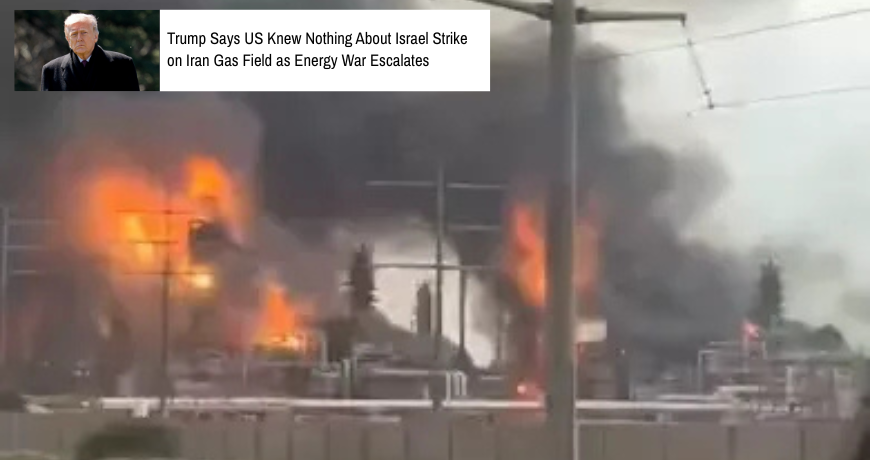
Donald Trump said the US had no prior knowledge of Israel’s strike on Iran’s main gas field.
The attack targeted South Pars gas field, the largest natural gas field in the world.
Trump warned Iran that the US could destroy the entire gas field if Tehran continues retaliation.
Iran responded by striking Ras Laffan in Qatar, a major LNG export site.
Gas prices surged 35%, while oil prices climbed to around $110 per barrel.
US President Donald Trump has said the United States had no prior knowledge of Israel’s attack on Iran’s largest gas field, highlighting growing tension between Washington and Israel.
The strike targeted South Pars gas field, the world’s biggest natural gas field. The attack triggered a rapid escalation across the Gulf, including strikes on LNG facilities, oil tankers, and energy infrastructure in multiple countries.
Trump: “The US Knew Nothing”
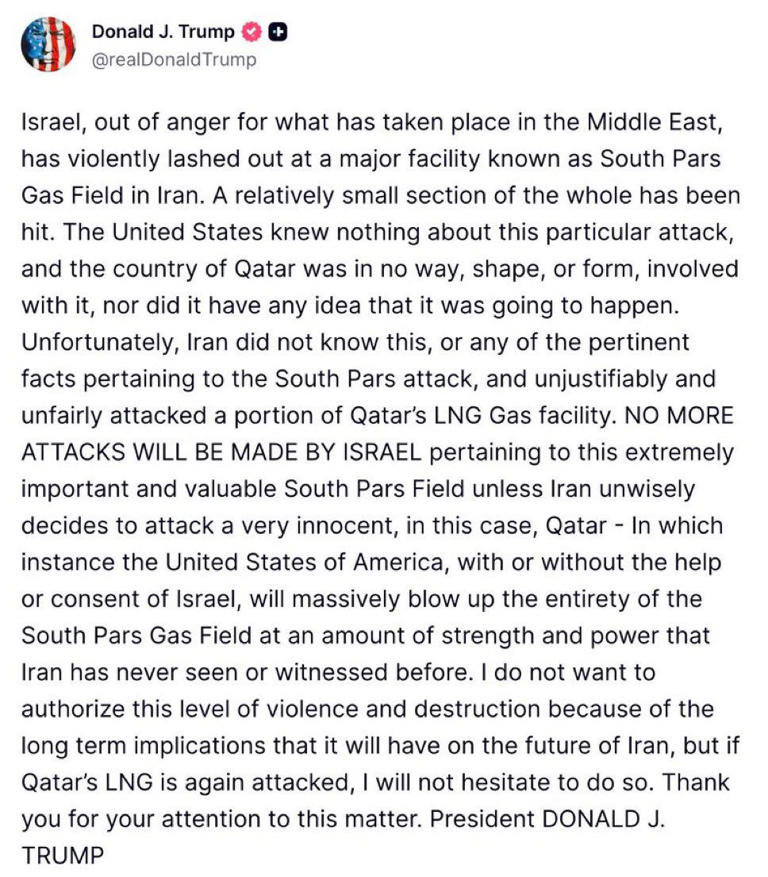
In a post on Truth Social, Trump said:
“The United States knew nothing about this particular attack, and the country of Qatar was in no way, shape, or form involved with it.”
However, Trump also issued a strong warning to Tehran, saying that if Iran continued its retaliation, the US would “massively blow up the entirety of the South Pars gas field” with unprecedented force.
His comments suggest a sharp contradiction: denying knowledge of the attack while threatening overwhelming retaliation.
Israel-Iran Energy Escalation
Iran responded to Israel’s strike by launching attacks on Ras Laffan, Qatar’s major LNG export facility, hitting it twice on Thursday.
Later the same day:
Iran struck Saudi Arabia’s Samref refinery
An oil tanker was hit near Strait of Hormuz
Oil prices surged to around $110 per barrel
Gas prices jumped 35 percent
The UK Maritime Trade Operations confirmed a vessel was hit near Khor Fakkan, causing a fire onboard.
Conflicting Accounts Over US Role
Despite Trump’s denial, Israeli military sources told Hebrew media that the strike on South Pars was coordinated with the US.
US officials later told the Wall Street Journal that Trump had authorised the strike, believing it would pressure Iran to reopen shipping through the Strait of Hormuz.
This has raised serious questions about:
US decision-making
Coordination with Israel
Control over escalation risks
Growing Split Between the US and Israel
This controversy marks a clear break between Washington and Tel Aviv.
Israeli strategists reportedly believe attacking civilian energy infrastructure can weaken Iran’s government by turning public opinion against it.
The US, however, appears increasingly concerned about:
Regional backlash
Global energy shock
Long-term damage to civilian infrastructure
Gulf states were reportedly furious and lobbied Washington to stop further Israeli strikes on Iranian energy sites.
Expert Warning: Energy Attacks Have Long-Term Impact
Energy analysts warn the damage could last years.
Saul Kavonic of MST Financial told the Financial Times:
“If a few million barrels of production are lost, there is no way to refill stocks even after the war ends.”
He added that LNG facilities are especially vulnerable, as repairs can take years, not months.
This was the first time a fossil fuel production site was directly hit in the conflict, marking a new and dangerous phase of the war that began on February 28.
Regional and International Reactions (Update)
Oman
Badr Albusaidi, Oman’s foreign minister, wrote that the US has “lost control of its own foreign policy”, warning that neither Iran nor the US has anything to gain from continuing the war.
United Kingdom
UK trade minister Chris Bryant criticised Trump’s approach as “very, very confusing”, saying there was no clear US strategy.
The UK government under Keir Starmer continues to push for de-escalation and an end to the conflict.
Political Pressure Inside the US
Trump is also facing pressure at home.
Much of his MAGA base supports:
Isolationist foreign policy
Reduced involvement in Middle East wars
Less automatic support for Israel
The resignation of Joe Kent, head of the National Counterterrorism Center, has added to the controversy. Kent said Trump had been “deceived” into entering the war.
What This Means Going Forward
Energy infrastructure is now a primary battlefield
Global oil and gas markets remain at risk
Gulf states are questioning US leadership
The risk of wider regional war is rising
Attacks on gas and LNG facilities represent a red line escalation with consequences that could last long after the fighting stops.